

News Center
Recommending Products
Contact: Mr. Jin
Tel: 13901575780
0512-52428686
Contact: Mr. Zha
Tel: 13913639797
0512-52422071
Address: No. 59, Huyi Road, Liantang, Shanghu Town, Changshu City, Jiangsu Province.
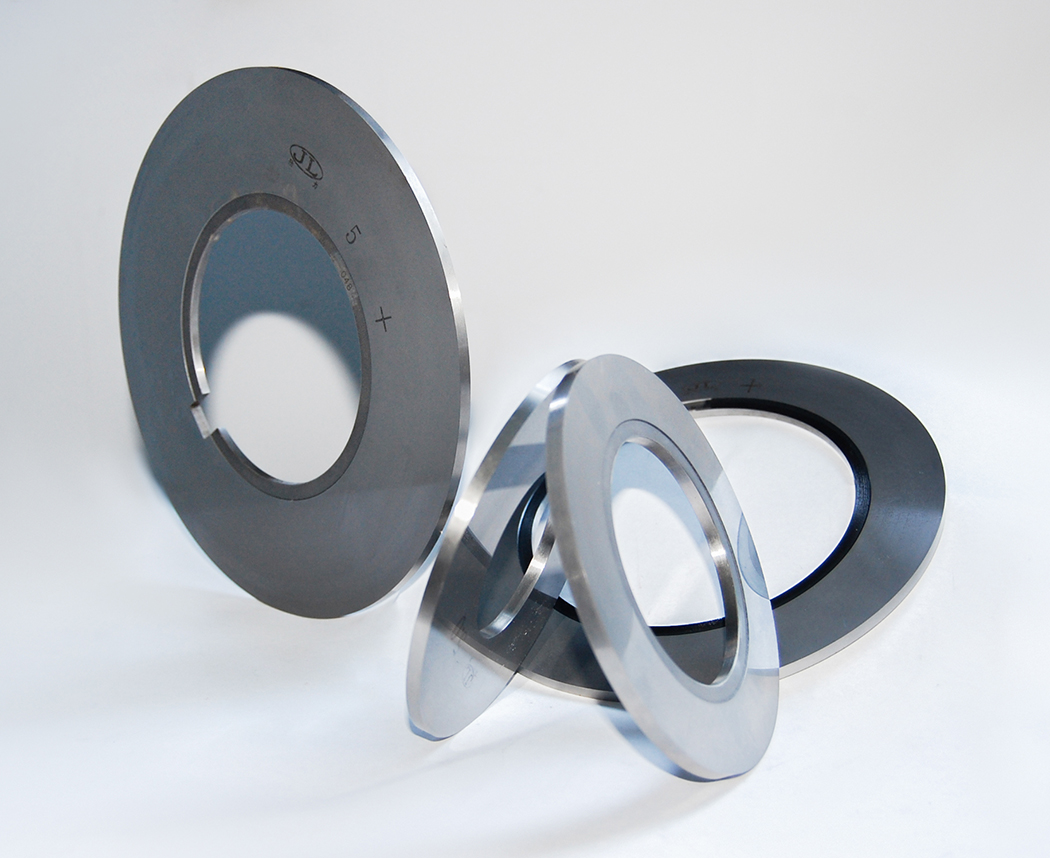
What factors affect the service life of the slitting round knife
The service life of a slitting circular knife (usually measured by "effective cutting mileage" or "cutting frequency") depends on three dimensions: the material of the knife body, cutting conditions, and maintenance. The service life varies significantly in different scenarios (such as thin film slitting up to hundreds of thousands of meters, metal foil slitting may only be tens of thousands of meters). The following are the key factors that affect its service life, classified and explained in combination with industrial practical application scenarios:Sources:m.dmees.cn | PublishDate:2025.11.25
1、 The core characteristics of the blade itself (lifespan basis)
1. Material and hardness of the blade body
Material selection:
High speed steel (HSS): hardness HRC 62-65, suitable for low hardness materials such as paper and non-woven fabrics, with a short lifespan (10000-50000 meters in conventional scenarios), but low cost and easy to grind;
Hard alloy (tungsten steel): with a hardness of HRC 89-93, it is wear-resistant and heat-resistant, suitable for medium to high hardness materials such as thin films, metal foils, and thin plates. Its service life is 5-10 times that of high-speed steel (50000-500000 meters), but it is brittle and afraid of impact;
SKH-51/SKH-9 high-speed steel: containing cobalt alloy, hardness HRC 65-68, better wear resistance than ordinary high-speed steel, with a lifespan 30% -50% higher than ordinary HSS, suitable for medium strength materials such as thick cardboard and synthetic cloth;
Coated blade body (TiN, TiAlN, DLC coating): A wear-resistant coating (hardness up to HV 2000 or above) is plated on the surface of the base material to reduce the friction coefficient of the cutting edge. The lifespan of the blade body is 2-3 times longer than that of an uncoated blade body, suitable for adhesive materials (such as PVC film, tape) or high-speed cutting scenarios.
Influence logic: The higher the hardness and wear resistance, the harder the cutting edge is to wear, and the longer the lifespan; But the brittleness of the material needs to be matched with the cutting material (such as when cutting thick and hard materials with a hard alloy knife, it is easy to break the blade due to impact, which can actually shorten the service life).
2. Processing accuracy of blade body and blade edge design
Processing accuracy: Errors in the roundness of the blade body and excessive end face runout (>0.003mm) can cause uneven force on the cutting edge during cutting, leading to increased local wear; When the roughness Ra of the cutting edge is greater than 0.02 μ m, it is easy for material residue to adhere, causing wear or cracking of the cutting edge;
Blade design:
Ultra thin blade (thickness ≤ 0.01mm): suitable for thin films and foils, but with low blade strength, it is prone to breakage when cutting thick and hard materials;
Micro tooth cutting edge (tooth pitch 0.1-0.5mm): suitable for paper and non-woven fabrics, dispersing cutting stress and reducing edge wear;
Blade angle: Sharp angles (30-45 °) are suitable for soft materials, while obtuse angles (60-90 °) are suitable for hard materials. Improper angles can cause blade compression wear (such as sharp angles cutting hard materials easily rolling the blade).
2、 The core impact of cutting conditions (key life variables)
1. Characteristics of cutting materials
Material hardness: The closer the material hardness is to the blade hardness, the faster the blade wear (such as cutting stainless steel foil (hardness HV 200-300), the shorter the blade life of cutting PE film (HV 50-80) by more than 80%);
Material abrasiveness: Materials containing fibers, fillers, or particles (such as glass fiber cloth, carbon fiber composite materials, and paper with added talcum powder) will grind the cutting edge like "sandpaper", greatly reducing the lifespan (such as cutting glass fiber cloth with a blade lifespan of only a few kilometers);
Material viscosity and temperature: Viscous materials (such as PVC film, hot melt adhesive film) are prone to sticking to the cutting edge, causing material accumulation and increased friction, and require a coated blade body; High temperature materials (such as high-temperature steaming film and thermoforming materials) will soften the material of the blade body, reduce wear resistance, and shorten its lifespan;
Material thickness: When cutting thick materials (such as cardboard or rubber sheets with a thickness of over 1mm), the cutting edge is subjected to high force and intense compression friction, resulting in a lifespan 50% -70% shorter than cutting thin materials (<0.1mm film).
2. Cutting equipment and process parameters
Equipment accuracy:
Coaxiality and parallelism errors of the blade axis (>0.005mm): causing local force concentration, uneven wear, and even blade breakage at the cutting edge;
Cutting board/cutting accuracy: Poor flatness (>0.005mm) or insufficient hardness of the cutting board can lead to "virtual cutting" or squeezing of the cutting edge, exacerbating wear and tear;
Tension control: Excessive fluctuations in material tension (>± 5%) can cause unstable force on the cutting edge during cutting, resulting in impact wear of the cutting edge;
Process parameters:
Cutting speed: When the speed is too fast (>500m/min), the friction between the cutting edge and the material heats up (temperature can reach 100-200 ℃), softens the cutting edge material, and accelerates wear (such as when cutting thin films at high speed, for every 20% increase in speed, the service life decreases by 15% -20%);
Knife clearance: The clearance is too small (less than 0.1 times the thickness of the material), and the cutting edge is excessively squeezed against the cutting board, resulting in severe wear; If the gap is too large (>0.5 times the thickness of the material), the material is prone to tearing, and the cutting edge is subjected to uneven force, which also shortens the service life (the gap is 0.1-0.3 times the thickness of the material);
Cutting method: The cutting edge wear of the shearing type (with upper and lower knives combined) is smaller than that of the squeezing type (with knives and cutting boards squeezing), and the service life is 30% -50% longer.
3、 Standardization of use and maintenance (key to extending lifespan)
1. Installation and commissioning
Installation operation: Impact or collision with the blade during installation can cause the edge of the blade to break or the blade to deform, directly shortening its lifespan; Uneven locking torque (> ± 5N · m) can cause the blade to rotate and move, resulting in uneven wear of the cutting edge;
Debugging accuracy: Failure to calibrate the coaxiality and parallelism of the tool shaft, or improper adjustment of the tool clearance, can lead to long-term abnormal force on the cutting edge, accelerating wear (such as a parallelism error of 0.01mm, which may reduce the lifespan by 40%).
2. Daily use and cleaning
Cleaning and maintenance: Failure to clean the accumulated material and dust at the cutting edge in a timely manner after cutting viscous or dusty materials can lead to solidification of the accumulated material and grinding of the cutting edge (such as after cutting PVC film, residual material adheres to the cutting edge, which will aggravate wear and tear in the next use);
Avoid accidental cutting: During the cutting process, foreign objects (such as metal shavings and sand particles) are carried in the material, which can instantly impact the cutting edge, causing the blade to break or curl, and directly scrap it;
Shutdown protection: Failure to apply rust proof oil to the cutting edge during long-term shutdown (especially in humid environments) can cause rusting of the cutting edge, affecting its service life.
3. Grinding and repairing of blade edges
Grinding timing: If the cutting edge is passivated (manifested as increased burrs and excessive size deviation) and not ground in a timely manner, continued use can lead to excessive wear of the cutting edge, even irreparable (such as high-speed steel knives can be ground 3-5 times, hard alloy knives can be ground 1-2 times, and the service life of each grinding can be restored to 70% -90% of the new knife);
Grinding process: Improper selection of grinding wheel during grinding (such as using a regular grinding wheel to grind hard alloy knives) and deviation of grinding angle (>± 2 °) can lead to a decrease in cutting edge accuracy, accelerated wear, and even a lifespan of only 50% of the new knife after grinding.
4、 Indirect effects of environmental factors
1. Working environment
Temperature and humidity: High temperature and high humidity environments (temperature>40 ℃, humidity>85%) will accelerate the corrosion of the blade body (especially high-speed steel blades), while reducing the lubrication effect and intensifying the friction and wear of the blade edge;
Dust and corrosive gases: Dust environments (such as mining and cement industry slitting) can cause dust to enter the blade shaft or edge, causing grinding and wear; Corrosive gas environments (such as cutting in the chemical industry) can corrode the material of the blade, reduce hardness, and shorten its lifespan.
2. Lubrication and cooling
Failure to use lubricating fluid or improper selection of lubricating fluid (such as lubricating viscous materials with ordinary engine oil) can lead to an increase in the friction coefficient of the cutting edge and intensified wear;
Insufficient cooling (such as not cooling in time during high-speed cutting), high blade temperature, softening of material, and decreased wear resistance (such as when the hardness of a hard alloy knife is significantly reduced above 200 ℃).